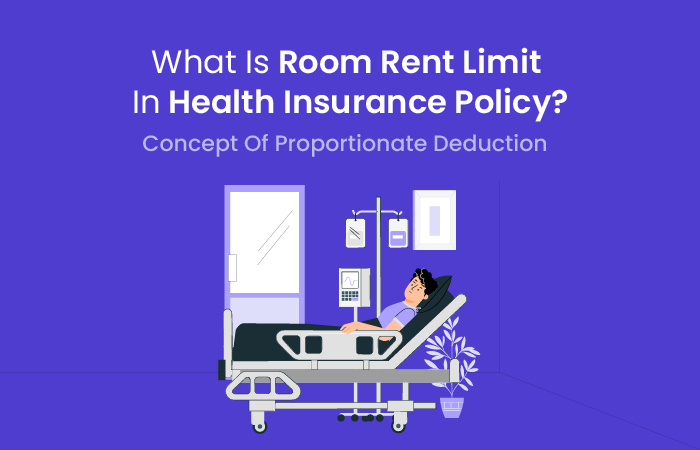
What is a room rent limit in a health insurance policy? Every health insurance plan comes with a set of components that can drastically change the claim amount during the time of billing.The hospital room rent limit is nothing but the specific amount of rent u pay for staying in a hospital. You will occupy a bed or opt for a room in the hospital. For this service, room charges will be levied on a daily basis.
There are different types of room rent limits that insurers impose based on the policy you’ve bought –
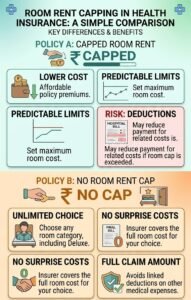
- Financial Limit Insurers generally put room rent limit at 1% of the Sum Insured So for a 5 lakh sum insured the limit is at Rs 5,000/day
- Room Category Limit:- Some insurance plans cover specific types of rooms – such as private room or shared accommodation. This kind of a limit ensures that you have the type of room, regardless of the cost of it.
The Hidden Cost of a Hospital Bed: Why “No Room Rent Limit” is a Lifesaver
The Escape Route: Benefits of “No Room Rent Limit”
Here is what you gain when you remove this restriction:
- 100% Bill Settlement: Without a room rent limit, there is zero proportionate deduction. If your bill is ₹4 Lakhs and within your sum insured, the insurer pays ₹4 Lakhs.
- Freedom in Emergencies: In a crisis, you take whatever bed is available to save your loved one. A “No Limit” policy ensures you aren’t financially punished for a hospital’s lack of general ward beds.
- Inflation Protection: Medical inflation is skyrocketing. A ₹5,000/day limit might get you a good room today, but in five years, it might barely cover a shared ward. Removing the limit future-proofs your policy.
The Disadvantages: The Trade-offs to Expect
Transparency is key, and “No Room Rent Limit” isn’t a magical free pass. Here are the realities you have to face:
- Higher Premiums upfront: Policies with absolutely no limits usually cost roughly 10% to 20% more in annual premiums. Salesmen avoid selling these because the higher price tag makes it harder to close the deal quickly.
- The “Suite” Illusion: Even with “No Limit” policies, almost all insurers explicitly exclude ultra-luxury accommodations like Presidential Suites or Royal Suites. Usually, the actual cap is a “Single Private AC Room.”
- Network Hospital Restrictions: Even if you have no room rent limit, if you go to a non-network hospital, you might still face co-payments or lower reimbursement rates depending on your policy’s broader terms.

At a Glance: Limit vs. No Limit
Feature | Policy with Room Rent Limit (1%) | Policy with NO Room Rent Limit |
Room Choice | Highly restricted to policy limits. | Freedom to choose (up to Single Private). |
Proportionate Deduction | Yes. Slashes surgeon and OT fees. | No. Full fees are covered. |
Premium Cost | Lower (looks cheaper on paper). | Slightly higher (pays off during claims). |
Peace of Mind | Low. You must calculate costs while stressed. | High. Focus purely on recovery. |
Let take an example with this scenario how a hidden clause turned a moment of relief into a financial nightmare, and why a “No Room Rent Limit” policy is the shield you actually need.
Ritika has bought a policy for her father to get cover from all unforeseen situation she could face in the future so that she don’t have to spare the medical cost from her corpus but while purchasing the policy she left something which was later made her regret.
Imagine this: You are rushing your father to the hospital in the middle of the night. It’s an emergency. You reach the reception, and they tell you, “We only have a Private AC Room available right now.” You nod without thinking twice—after all, you have a ₹10 Lakh health insurance policy. You focus on your father’s recovery, assuming the insurance company has your back.
Ritika’s father want to get admit in the hospital, she had insisted on a policy with No Room Rent Limit, her experience would have been completely different.
This was exactly Ritika’s situation. But when it was time to leave the hospital, her relief turned into absolute shock.
The Trap of the “1% Rule”
Ritika’s father had a successful surgery, and the total hospital bill came to ₹4,00,000. She confidently handed over her insurance card, expecting a cashless checkout.
A few hours later, the billing department informed her that the insurance company approved only ₹2,00,000. Ritika had to pay the remaining ₹2,00,000 out of her own pocket.
How did a ₹10 Lakh policy only pay out ₹2 Lakhs? The answer lies in the fine print. Ritika’s policy had a 1% Room Rent Limit. This means her policy only covered a hospital room up to ₹10,000 per day (1% of her ₹10 Lakh sum insured). The Private AC room she took cost ₹20,000 per day.
Ritika thought she would just have to pay the ₹10,000 difference for the room. But that is not how health insurance works.
How Advisor/Customer Care guy Fool You: The “Proportionate Deduction” Secret
When Ritika bought the policy, the salesman enthusiastically highlighted the massive ₹10 Lakh cover. But he intentionally left out the dark side of the Room Rent Limit: Proportionate Deduction.
- The Half-Truth: Salesmen often say, “If you take a more expensive room, you just pay the difference.” This is technically true for the room, but disastrously false for the rest of the bill.
- The Brutal Reality: Because Ritika chose a room that was exactly doubleher allowed limit, the insurance company applied that same ratio to the entire hospital bill. They cut the surgeon’s fees by 50%. They cut the OT charges by 50%. They cut the nursing charges by 50%.
The salesman secured his commission by selling a cheaper policy, but Ritika paid the ultimate price.
When buying health insurance, the size of the total cover (Sum Insured) is only half the battle. The real power of a policy lies in its sub-limits. Don’t let a slick sales pitch distract you from the fine print that actually dictates your claim.
Reach out to us thru
Website:-https://herculesadvisors.in/
Twitter:-https://x.com/NIKHILLJHA
Instagram:-https://www.instagram.com/herculesadvisors/
Youtube:-https://www.youtube.com/@HerculesInsurance
Email us on:-nikhiljha159@gmail.com