
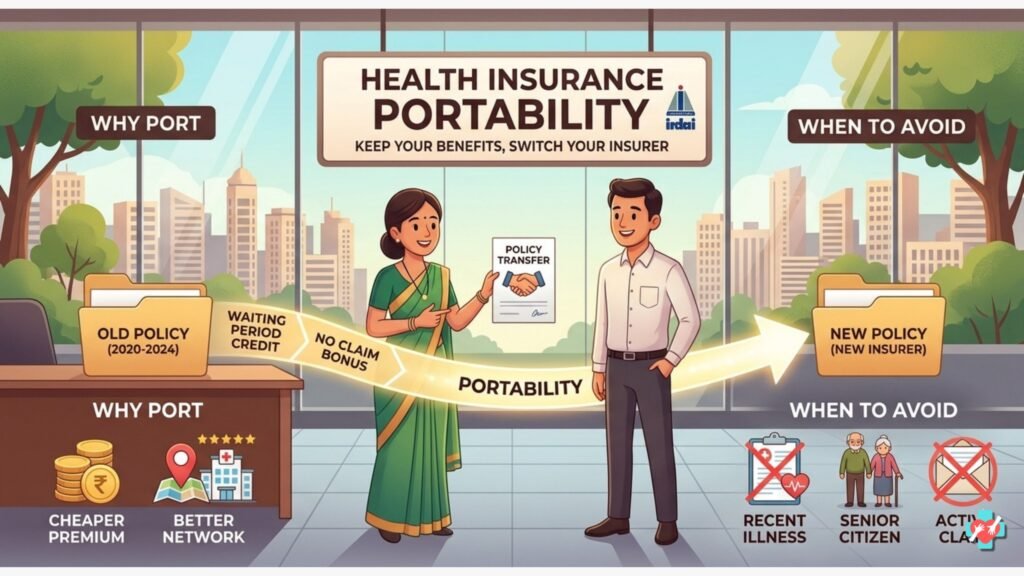
Think of your health insurance like a mobile connection. If you aren’t happy with the network or the price, you don’t throw away your phone number—you “port” it to a new provider. Health Insurance Portability works the same way. It allows you to switch your insurance company while keeping the “credits” you’ve earned over the years.
What is Health Insurance Portability?
Definition: Portability is a right provided by the IRDAI (Insurance Regulatory and Development Authority of India) that allows a policyholder to transfer their existing health insurance policy to another insurer.
The biggest advantage is that you do not lose your continuity benefits, such as the time you have already spent waiting for coverage of pre-existing diseases (PEDs) or specific illnesses (like cataracts or stones).
Key Terms & Conditions
Porting isn’t an “anytime” feature. It comes with specific rules to ensure a smooth transition:
- Timing is Everything:You can only port at the time of renewal. You must apply to the new insurer at least 45 days (but not more than 60 days) before your current policy expires.
- Continuous Coverage:Your current policy must be active. If there is a “break” or lapse in your policy, you lose the right to port.
- Like-to-Like Plans:You can typically only port between similar types of policies (e.g., from one indemnity-based plan to another).
- Underwriting Rights:The new insurance company has the right to accept or reject your application based on their own risk assessment. They might also ask you to undergo a fresh medical check-up.
- The “New” Sum Insured Rule:If you increase your coverage amount (Sum Insured) during the port, the waiting period credit only applies to the old The extra coverage will be treated as a brand-new policy with fresh waiting periods.
Is it Useful to Port?
Porting is highly beneficial if you find yourself in these situations:
- Lower Premiums:Another company offers the same (or better) coverage at a much lower cost.
- Better Features:You want a plan that offers modern benefits like No Room Rent Capping, restoration of sum insured, or maternity coverage.
- Wider Hospital Network:Your current insurer doesn’t have enough “cashless” hospitals in your city or near your home.
- Service Issues:You’ve had a bad experience with claim settlements or poor customer support.
Accumulated Bonus: You can carry forward your No Claim Bonus (NCB) to the new policy, increasing your total cover with paying extra charges.
When to AVOID Portability
Sometimes, staying with your current insurer is the smarter move. Avoid porting if:
- You Have a Recent Major Illness:If you were recently diagnosed with a serious condition (like heart disease or cancer), a new insurer is likely to reject your application or charge a very high “loading” fee.
- You are a Senior Citizen (65+):Many insurers are hesitant to take on new elderly clients. You might face strict co-payment clauses or limited plan options compared to the “loyal customer” status you have with your current company.
- You are Close to the “Moratorium Period”:Once you complete 5 continuous years with an insurer (the moratorium period), they generally cannot contest a claim except for proven fraud. If you port, you might have to build that “trust period” again with the new company. While porting there will be no break in your Moratorium Period.
- Satisfactory Service:If your current insurer has a fast claim process and good service, don’t switch just to save a few hundred rupees. A “known” reliable insurer is often better than an “unknown” cheaper one.
- Active Treatment:If you are currently undergoing a series of treatments or a planned surgery is coming up soon, porting can lead to administrative delays and claim complications.
Reach out to us thru


